Ring Size
Finding your size.
A ring should slide over the knuckle with gentle resistance and sit without spinning. This guide covers how to measure at home, how sizes convert between countries, and the small things that change the fit.
01
Visit the atelier
The most reliable way. We measure your finger in person, in the band width of your actual design, and note it on your commission.
02
Measure at home
A length of string, a strip of paper, or a ring that already fits. Accurate to within about half a size if you follow the notes below.
03
Trace a ring you own
Place a ring that already fits over a ruler, or trace its inside circle on paper and photograph it beside one. Send it to us and we will read the size from it.
Two Methods
Measuring at home.
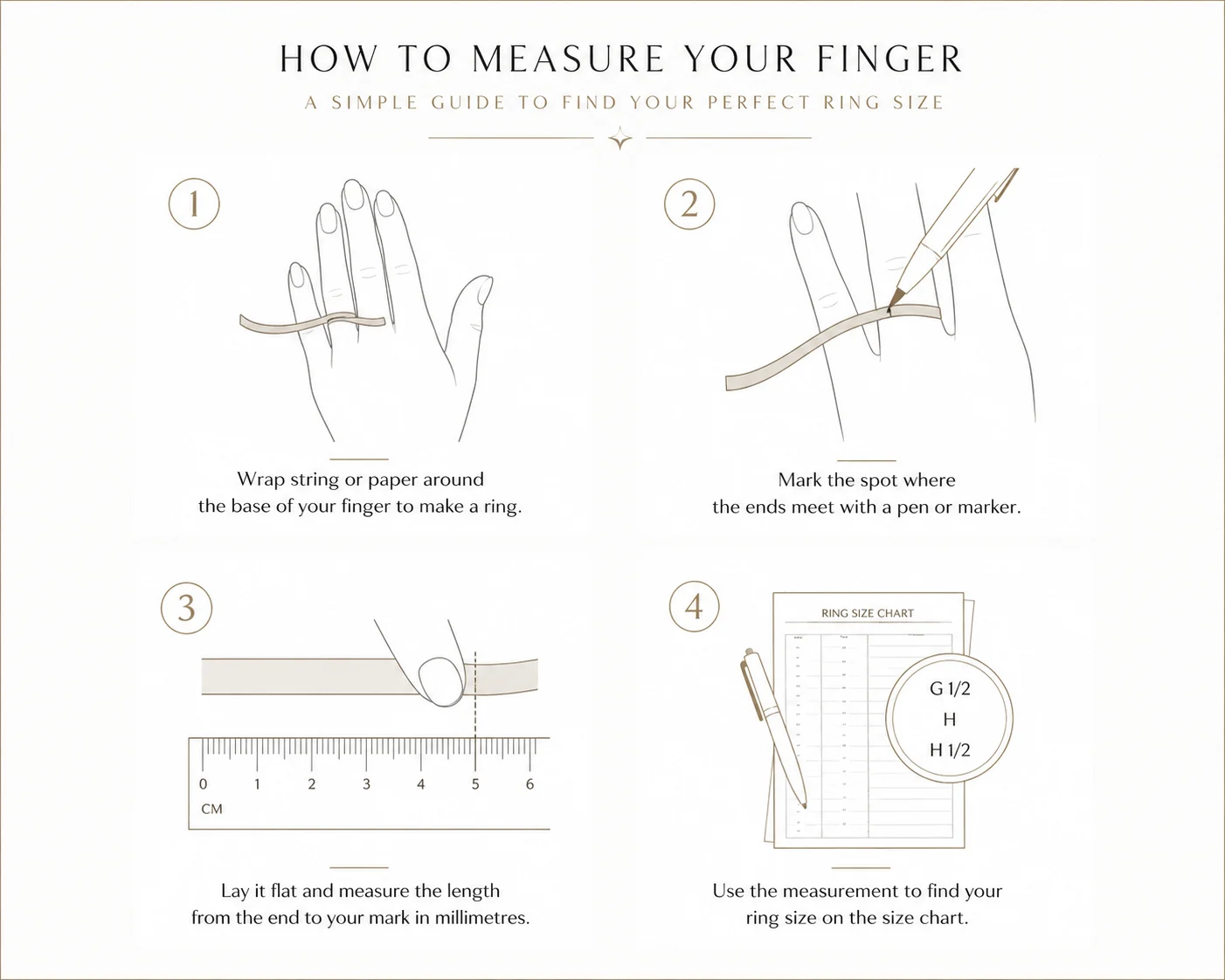
Paper or string
Cut a strip of paper about 5 mm wide, or use a length of non-stretch string. Wrap it around the base of the finger, snug but not tight, and mark where the ends meet. Lay it flat against a ruler and read the length in millimetres — that is your circumference. Enter it in the quick conversion below, or divide it by 3.14 to get the inside diameter the chart is built on. Measure three times, at different moments of the day, and take the largest reading.
An existing ring
Take a ring that already fits the correct finger and place it over a ruler. Measure the inside edge to inside edge, straight through the centre — that is the inside diameter. Match it to the diameter column in the chart below. This works only if the ring belongs on the same finger as the new piece; fingers on the same hand can differ by a full size.
Conversion Chart
Sizes across countries.
Quick conversion
Enter the circumference you measured — the wrap-around length in millimetres, not the diameter — and we will show the nearest US size.
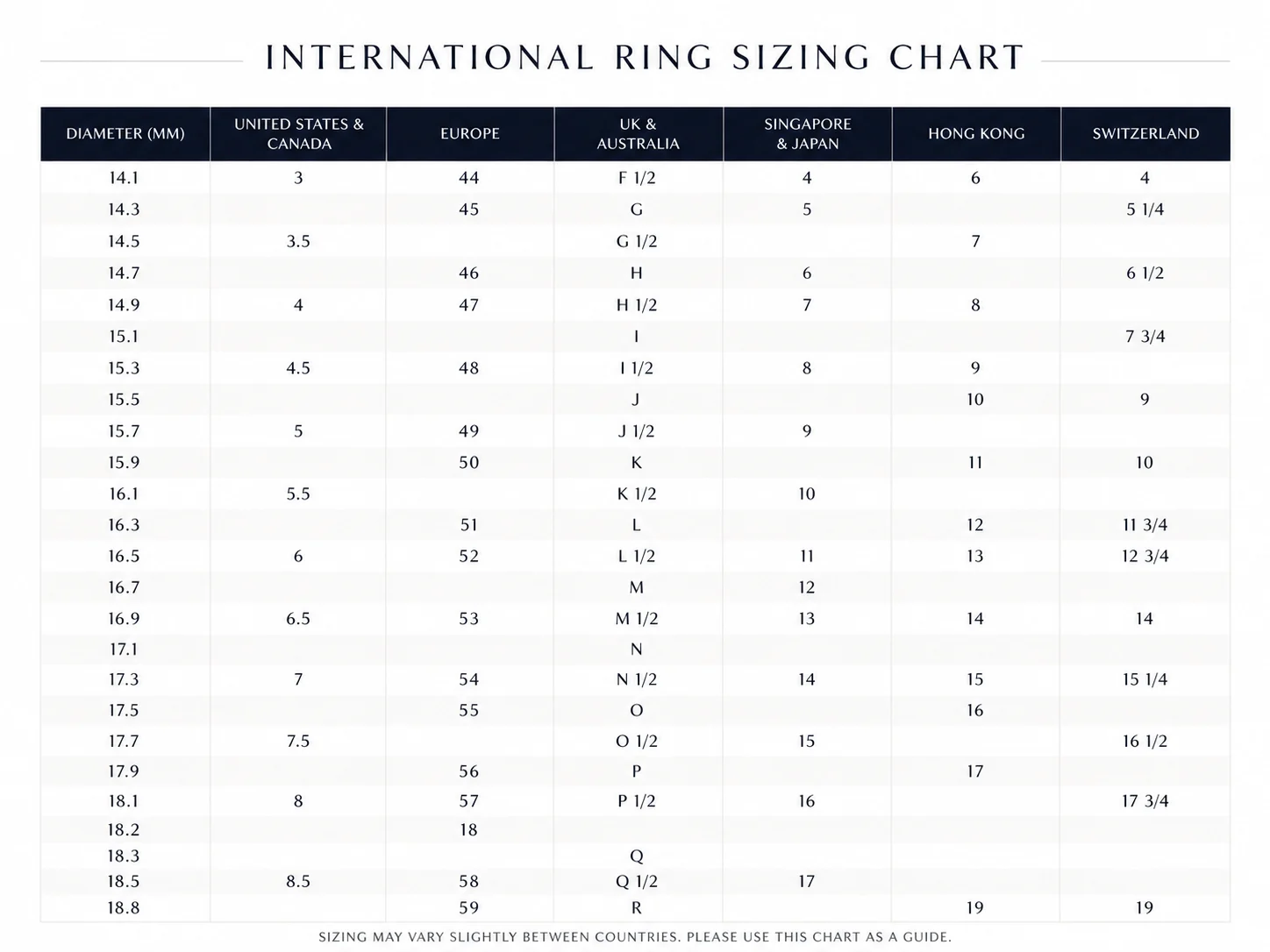
Thai jewellers often work to their own numbering rather than a single standard. If you have been sized locally, bring the number and we will confirm it against the standard sizes in the chart, which covers the range we are asked for most often.
Fit
Five things that change the fit.
Temperature
Fingers contract in air conditioning and swell in Bangkok heat. Measure at a comfortable room temperature, never straight after a flight.
Time of day
Hands are at their smallest in the morning and largest in the evening. Late afternoon is the fairest reading.
The knuckle
If the knuckle is noticeably wider than the base of the finger, size for the knuckle and let us add small internal beads so the ring does not spin.
Band width
A wide band feels tighter than a narrow one at the same size. Above roughly 6 mm, expect to go up a quarter to a half size.
The setting
A heavy stone shifts weight to one side. We account for this in the shank when the design calls for it.
Proposals
Sizing a ring without asking.
01
Borrow and trace
Take a ring she already wears on the correct finger, press it into soft soap or clay, or trace the inside circle on paper and photograph it beside a ruler. Send it to us — we can work from that.
02
Ask one person
A sister, a close friend, or her mother almost always knows. It is the least risky route and the secret usually holds.
03
Size slightly large
If nothing is certain, we make it a half size up. A ring that is loose can be worn on the day; one that will not pass the knuckle cannot.
Most of our settings can be resized after delivery. Eternity bands and channel-set designs are the exceptions — we will tell you plainly at the design stage which category your piece falls into.
Frequently Asked
Questions we hear often.
What is the most common ring size?
For women in Thailand, US 5 to 6½. For men, US 9 to 10½. These are averages and worth nothing next to an actual measurement.
How tight should a ring feel?
It should need a little effort over the knuckle and resist coming back off. If it slides off with a shake, it is a half size too large.
Can you resize my ring later?
In most cases yes, usually within a size or two either way. Full eternity bands, channel settings and some engraved designs cannot be resized without remaking the shank.
Do you charge for resizing?
The first adjustment on a piece we made is complimentary. We will quote anything beyond that before starting.
Can I measure with a printed paper sizer?
We would rather you did not. Home printers scale pages by a few percent, which is enough to shift the reading by a full size. Use string or an existing ring instead, and we will confirm the size in person.
My fingers change size through the year. What then?
Size to your everyday reading, and we can design the shank so it can be adjusted more easily later. Tell us during the consultation.